
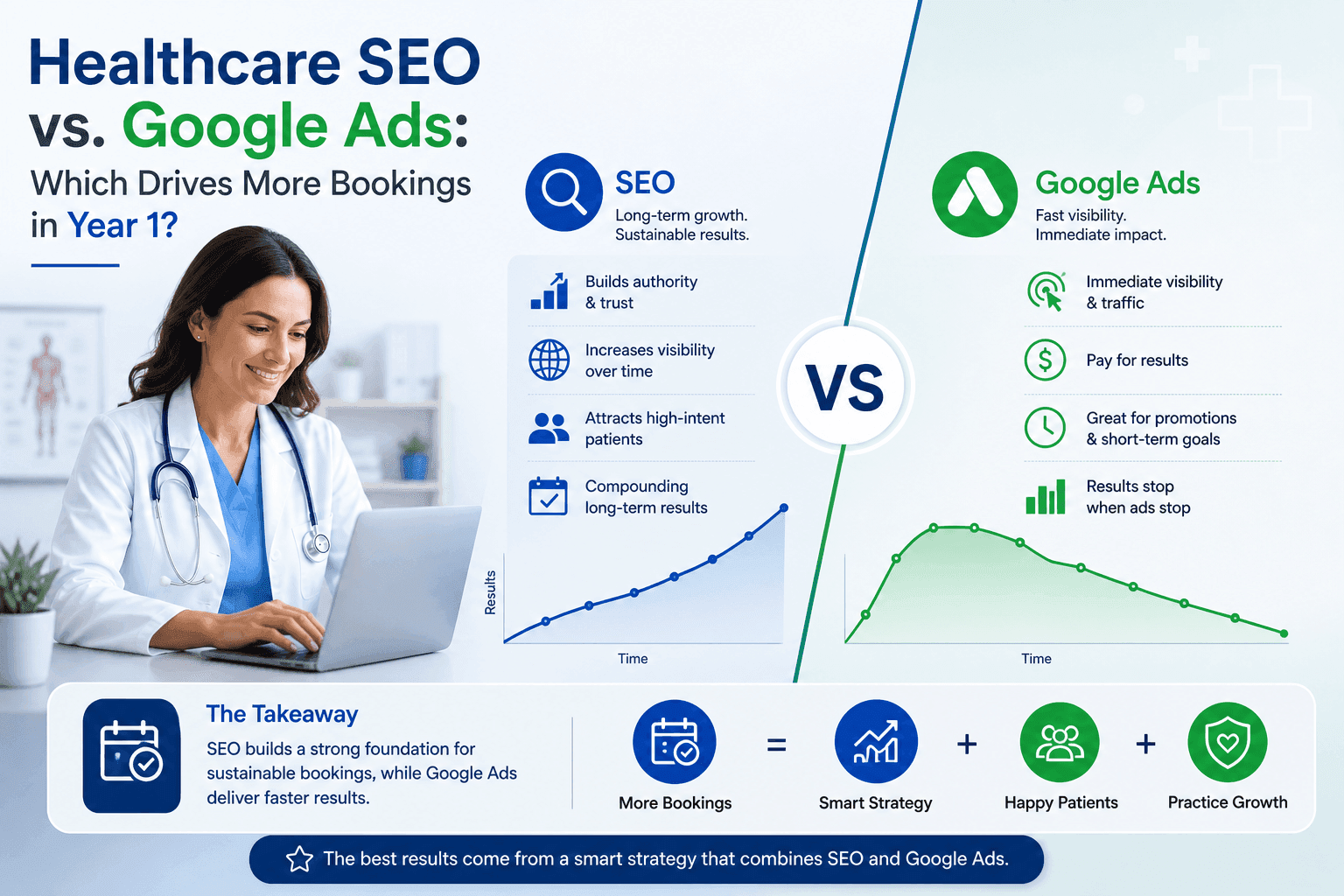
Healthcare SEO vs. Google Ads: Which Drives More Bookings in Year 1?
Last updated: 5 May 2026 · 8 min read
If you run a clinic and you've been looking at your marketing budget wondering where to put it, you've hit the same fork in the road every clinic owner faces: SEO or Google Ads?
You've probably heard arguments both ways. SEO agencies tell you ads are a money pit. Ads agencies tell you SEO is too slow. The honest answer — the one most marketing companies don't lead with because it's harder to sell — is that the right choice depends on your stage, your competition, your budget, and how patient you can afford to be.
This guide cuts through that. We'll explain how each channel actually works, where each one wins, where each one fails, and how clinics in Australia get the best of both with a hybrid approach. No agency bias, no fluff — just a clear comparison so you can decide where your first dollar belongs.
Key takeaways (TL;DR)
- SEO drives bookings through unpaid Google rankings — slow to build, but compounds for years.
- Google Ads drive bookings through paid placement — instant visibility, but stops the moment you stop paying.
- For most clinics, the right Year 1 answer is a hybrid: ads to fill the calendar now, SEO to reduce dependence on ads later.
- A 60/40 ads-to-SEO split early on, shifting toward 40/60 as SEO compounds, works well for most general practice and allied health clinics.
- Cosmetic, dental, and high-competition metro clinics usually need higher Google Ads investment to stay visible.
- Whichever you choose, AHPRA's advertising guidelines apply the same way — both channels are regulated advertising.
- The wrong question is "SEO or Ads?" The right question is "What mix gets us bookings now and lower acquisition costs later?"
A note before we start: This is an agency-neutral comparison. We sell both SEO and Google Ads at PMGS, and we have no incentive to push you toward one or the other. Our incentive is to recommend whatever genuinely grows your clinic, which usually means both — in the right ratio for your situation.
Why this question is harder to answer in 2026
The "SEO vs. ads" debate isn't new, but the answer has shifted significantly in the last 18 months. Three forces have changed the maths for healthcare clinics.
1. Google Ads costs have climbed
Cost-per-click for healthcare keywords in Australia has trended upward year over year, particularly in cosmetic, dental, and metro GP markets. Bidding wars between clinics in saturated suburbs have pushed cost-per-acquisition figures that would have looked unreasonable five years ago into "standard" territory. The honest read: ads still work, but they cost more for the same result.
2. AI Overviews are reshaping organic results
Google's AI Overviews — the AI-generated summaries that now appear above traditional search results — are changing how patients find clinics. Some informational queries ("what causes lower back pain", "signs of a cavity") now resolve without a click on a website at all. SEO still works, but ranking matters less than being cited as an authoritative source for the questions patients ask. Clinics with thin, generic content are losing visibility. Clinics with deep, well-structured educational content are gaining it — even when their domain authority is lower.
3. Patient behaviour has changed
Patients research differently than they did three years ago. They start on Google, jump to TikTok or Instagram for visual reassurance, check reviews on Healthengine, return to Google for directions, and may speak to ChatGPT before booking. The single-channel approach to clinic marketing is outdated. Whichever channel you start with, your patients aren't only on that one.
What this means for your decision
The old advice — "just do SEO" or "just run ads" — works for fewer clinics each year. The clinics doing well in 2026 understand both channels, run them in concert, and adjust their mix as their market shifts. The rest of this guide gives you the framework to do the same.
What healthcare SEO actually means
Search engine optimisation (SEO) is the practice of making your website appear higher in Google's unpaid (organic) search results.
When someone in Geelong searches "dentist near me", Google scans hundreds of local websites and ranks them based on relevance, location, content quality, reviews, and dozens of other signals. SEO is the work of making your clinic the answer Google chooses to show first — without paying for the privilege.
The four main components
- Local SEO — Google Business Profile optimisation, NAP consistency (name, address, phone), local citations, suburb-specific service pages. This is where most healthcare SEO wins are made.
- Technical SEO — How fast your site loads, how it works on mobile, how cleanly Google can crawl it. The plumbing. Google's own documentation on page experience and Core Web Vitals explains how these signals fit into Search.
- On-page SEO — Service pages, location pages, page titles, internal linking. The structure that tells Google what you do, who you do it for, and where.
- Content — Educational blog posts, FAQs, condition explainers. Content positions your clinic as authoritative — and feeds AI Overviews and ChatGPT citations.
How long it takes
SEO is not a fast channel. For most healthcare clinics in Australia:
- Months 1–2: Foundation work. No visible rankings yet.
- Months 3–6: Early movements. Possibly some local pack visibility for low-competition terms.
- Months 6–12: Meaningful rankings begin to translate into bookings.
- Year 2 onwards: Compounds. Costs stay flat while patient acquisition rises.
There are exceptions. A new clinic in a low-competition rural area might rank locally within 60 days. A cosmetic clinic in central Melbourne might not break the top 3 for over a year of consistent work. The harder the market, the longer the climb.
Why it's powerful
Once your rankings are established, the cost of each new patient drops dramatically. SEO is closer to building an asset than running a campaign. The site keeps working — and earning bookings — while you sleep, take leave, or change your other marketing strategy. That asset doesn't show up on a balance sheet, but it's worth real money the day you sell the practice.
What Google Ads actually means for clinics
Google Ads is a pay-per-click (PPC) advertising platform. You choose the search terms you want to appear for ("emergency dentist Brisbane", "skin check Hobart"), set a daily budget, and pay every time someone clicks through to your website. Your ad appears at the top of Google's search results — typically marked "Sponsored" — above the unpaid results. For how Search campaigns, auction dynamics, and Smart Bidding fit together, see Google Ads documentation on Search campaigns and Smart Bidding.
How the bidding works
You don't pay a fixed price for visibility. You bid against other clinics targeting the same keywords. The amount you actually pay per click depends on:
- How much competitors are willing to pay for the same keyword
- How relevant your ad is to the search (Google's Quality Score)
- How well your landing page matches the search intent
- Match type, time of day, device, and location
In healthcare specifically, costs vary widely. A search like "emergency dentist near me" typically costs significantly more per click than "family GP bulk billing [suburb]". Cosmetic procedure keywords sit at the high end. Allied health and niche specialty keywords sit lower.
Why it's powerful
- Instant visibility — your clinic can be on page one today.
- Predictable lead flow — once tuned, you can largely forecast bookings from weekly spend.
- Highly targeted — keywords, locations, time of day, devices, demographics.
- Measurable — see which keyword drove which booking.
- Easy to scale — increase budget, increase visibility (up to a point).
The catch
Every patient your ads bring you costs money. The moment you pause the budget, the bookings stop. If your cost-per-click is $20 and your conversion rate to booking is 5%, you're paying $400 to acquire each booking. Subtract treatment cost, your time, and overhead — and the maths gets uncomfortable for low-margin services.
Google Ads is a faucet. Open it and the water flows. Close it and it stops.
SEO vs. Google Ads: head-to-head
| Factor | Healthcare SEO | Google Ads |
|---|---|---|
| Speed to results | 3–12 months | 24 hours |
| Cost structure | Upfront investment, lower ongoing | Ongoing per-click cost |
| Cost over time | Decreases as rankings compound | Stays flat or increases |
| Trust signal | Higher (organic listings) | Lower ("Sponsored" badge) |
| Click-through rate | Higher for top organic | Lower than top organic |
| Scalability | Slow, gradual | Fast, immediate |
| Sustainability | Long-term asset | Stops when budget stops |
| Risk | Algorithm updates | Bid wars, account issues |
| Best for | Long-term growth | Fast bookings |
| AHPRA compliance | Same rules apply | Same rules apply |
One-line summary: Google Ads buys you bookings today. SEO earns you bookings tomorrow. The clinics that win Year 1 decide how much of each they need — and stop treating it as either/or.
When Google Ads is the right call
Four scenarios where Google Ads is usually the better starting point.
- New clinics that need bookings tomorrow — SEO won't fill slots this week; Ads can target high-intent searchers within hours.
- High-competition metro markets — established competitors own organic rankings; Ads buys visibility above them while SEO catches up.
- High-value treatments where CPA maths works — implants, orthodontics, complex cosmetic; $200–$400 CPA can make sense when lifetime value is $3k–$15k+.
- Time-limited campaigns — open days, new services, seasonal pushes (skin checks, flu vax). SEO can't pivot that fast.
When SEO is the smarter investment
- Clinics planning long-term growth — compounding rankings; lowest CPA often shows up in Years 2–5.
- Less competitive locations — suburban/regional/rural often sees traction in 4–6 months vs metro CBD timelines.
- Niche authority — paediatric dentistry, sports physio, women's mental health; depth of content wins organic trust.
- Lowering long-term acquisition cost — Ads CPA plateaus or rises; SEO cost-per-booking tends to fall as rankings compound.
Three truths most clinics learn the hard way
1. Ads stop working the moment you stop paying. Many clinics run Ads for years with no parallel SEO — then have no organic asset when spend pauses. Use Ads as a tap; build SEO as the tank underneath.
2. SEO gets cheaper over time. Month 1 and Month 12 often cost similar in fees — but Month 12 delivers far more bookings. After ~two years, organic CPA often fractions Ads CPA.
3. The biggest Ads mistake is wrong landing pages. "Emergency dentist Brunswick" → homepage = bounced intent. Every serious campaign needs intent-matched landing pages with clear booking and location — or you're roughly doubling CPA vs what you could achieve.
Real examples — what works and what doesn't
Concrete patterns from healthcare campaigns (AHPRA-compliant phrasing throughout).
Targeting
| Doesn't work: Broad keywords like "doctor" or "clinic" | Massive volume, low intent; you pay for clicks that never book. |
| Works: High-intent local terms — e.g. "bulk billing GP Northcote", "emergency dentist Footscray" |
Landing pages
| Doesn't work: All ad traffic to the homepage | High bounce; visitor wanted a specific answer. |
| Works: Dedicated landing page per ad group — service, booking, location |
Tracking
| Doesn't work: Ads with no conversion tracking | Blind optimisation; Google can't learn what converts. |
| Works: Phone, bookings, and forms as separate conversions |
SEO foundation
| Doesn't work: Ads only, SEO ignored for years | No organic asset when budget stops. |
| Works: Ads for near-term calendar + GBP, location pages, technical base |
Content strategy
| Doesn't work: Thin generic "SEO blogs" | Won't rank in 2026; won't earn AI citations. |
| Works: Deep educational content that reflects real expertise |
Local SEO
| Doesn't work: Incomplete or unverified Google Business Profile | Local pack suffers vs complete competitors. |
| Works: Verified GBP — categories, hours, services, photos, professional replies |
The hybrid strategy — why most clinics do best with both
Why it works: Google Ads fills this month's empty slots. SEO reduces permanent dependence on paid CPC inflation. Run both in parallel: calendar pressure down, long-term CPA trajectory improves.
As SEO compounds, organic bookings rise — you can dial back ad spend without losing total volume. Year 1, Ads often do the heavy lift; Year 3, SEO often does.
A typical Year 1 budget split (directional)
| Stage | Google Ads | SEO |
|---|---|---|
| Year 1, Q1–Q2 | 60–70% | 30–40% |
| Year 1, Q3–Q4 | ~50% | ~50% |
| Year 2 | ~40% | ~60% |
| Year 3+ | ~30% (targeted) | ~70% (compounding) |
Adjustments: Cosmetic/dental/high-margin → tilt Ads. GP/allied/lower margin → tilt SEO earlier. Rural/regional → SEO can carry more sooner. Brand-new clinic → lean Ads in Q1; SEO as parallel foundation.
Rule: Over years, shift the mix toward SEO. Clinics stuck at 70% Ads forever pay the inflation tax indefinitely.
Four mistakes that derail clinic marketing budgets
- Ads only — no organic asset; pause spend → bookings collapse.
- Expecting SEO in 8 weeks — pulling budget at month 3 wastes the foundation just before traction.
- Weak conversion tracking — can't scale what you can't measure; algorithm starved for signals.
- Poor website — fast, trustworthy, easy booking beats clever campaigns on a broken site. Fix conversion first.
ROI and realistic Year 1 expectations
Directional only — markets and execution vary.
Google Ads — Year 1: Month 1 tuning (high CPA). Months 2–3 CPA stabilises. Months 4–6 optimisation (often 20–30% CPA improvement). Months 7–12 often plateau unless you expand scope.
SEO — Year 1: Months 1–2 foundation. Months 3–4 early movement. Months 5–8 traction. Months 9–12 compounding; organic CPA often starts undercutting Ads.
Honest framing: Year 1 is rarely when SEO "pays back" in isolation — it's when you build the asset that pays in Years 2–3. If your only question is "more bookings in 12 months?" Ads usually wins. If "more bookings across 36 months at lower CPA?" the answer usually flips.
A quick decision framework
Answer honestly:
- Do you need bookings in the next 30 days?
- Do you have less than six months cash runway?
- Saturated metro market?
- High-margin services (implants, cosmetic, complex dental)?
- Brand-new clinic opening?
If 3+ yes: Lead with Google Ads; build SEO in parallel.
If 1–2 yes: Hybrid from day one (often ~50/50 to start).
If none: You can lead with SEO if you have runway and patience.
The simplest version
- Need patients fast? → Google Ads.
- Want long-term, lower-cost growth? → SEO.
- Want stability + scale? → Hybrid (most clinics).
Healthcare SEO vs. Google Ads: FAQ
Is SEO dead or evolving in 2026?
Evolving, not dead. AI Overviews change informational queries, but local and commercial intent ("dentist near me", "physiotherapist [suburb]") still drives strong clicks. Thin content dies; deep, expert content wins — especially for healthcare.
Is SEO more effective than Google Ads?
Depends on horizon. Year 1: Ads usually delivers more bookings (speed + scale). Years 3–5: SEO often wins on cost-per-booking and total return through compounding. Most clinics should run both and rebalance over time.
Who are the "big 3" of online advertising?
Globally and in Australia: Google (Search, Display, Performance Max), Meta (Facebook, Instagram), Microsoft (Bing Ads). For healthcare commercial intent, Google Search Ads typically leads; Meta suits awareness / longer cosmetic funnels; Microsoft can be a lower-cost supplement.
Is $20 a day good for Google Ads?
$20/day (~$600/mo) is a test budget for most metro healthcare CPCs ($10–30+ per click). Meaningful optimisation and steady bookings often need roughly $1,500–$5,000+/month depending on specialty and competition — your mileage varies.
How long does SEO take for an Australian clinic?
Broadly: early local movement 3–4 months; meaningful organic bookings often 6–12 months. Regional can be faster; saturated CBD may need 12–18 months for competitive head terms. Niches with lighter competition can beat averages.
Can I run Google Ads alongside SEO without them competing?
They complement. Paid + organic visibility on the same SERP often lifts total clicks versus either alone.
What's the cheapest way to grow a clinic long-term?
Usually word-of-mouth + mature local SEO + strong Google Business Profile. Ads are fastest, rarely cheapest over five years. Cheapest month one ≠ cheapest year five.
Do AHPRA rules apply to SEO and Google Ads?
Yes — both are regulated advertising under the National Law (testimonials, guarantees, Rx naming, misleading claims, cosmetic rules for under-18s, etc.). See our plain-English guide: AHPRA advertising guidelines for medical practices (2026).
Should a brand-new clinic invest in SEO from day one?
Yes — as secondary. Priority is usually Ads or strong referrals for immediate bookings; allocate a consistent smaller slice to SEO foundations (GBP, technical setup, location pages) so months 6–9 aren't starting from zero organically.
How do I know if my Google Ads agency is doing a good job?
Look for: (1) conversion tracking tied to real bookings, not vanity clicks; (2) cost-per-booking trending down month on month; (3) transparency into the live ad account. For healthcare, confirm AHPRA-aware copy — non-compliant ads can draw complaints regardless of CTR.
How Australian clinics get this right
Strong clinics treat SEO and Ads as complementary; invest in conversion tracking from day one; and rebalance budget as organic compounds rather than locking one ratio forever.
A real-world pattern
A Melbourne GP practice arrived after Year 1 spending heavily on Google Ads with minimal SEO — calendar depended on paid spend, and CPC creep squeezed margins. Over ~18 months we kept Ad spend roughly stable while building local SEO: optimised GBP, suburb service pages, AHPRA-compliant educational content, and a faster site. Organic bookings caught paid around month 18, exceeded paid by month 24, freeing budget to focus Ads on higher-margin services.
Full detail: Greater Geelong Medical Centre Google Ads case study.
How PMGS approaches healthcare marketing
- AHPRA compliance as the base layer for SEO and Ads — not an afterthought.
- SEO + Google Ads in-house — recommendations aren't skewed to one channel.
- Focus on cost-per-booking and patient lifetime value, not impressions alone.
Typical work: healthcare local + technical + content SEO; Google Ads with intent-led keywords and landing pages; conversion tracking (calls, forms, online bookings); compliance checks on organic and paid; hybrid roadmaps (12 / 24 / 36 months).
→ Healthcare marketing services
→ Talk to PMGS about your Year 1 strategy
Sources and further reading
- Google — Google Ads Help — How costs are calculated
- Google — Search Quality Evaluator Guidelines (E-E-A-T)
- AHPRA — Guidelines for advertising a regulated health service
- Australian Bureau of Statistics — healthcare and social assistance industry statistics
Related resources from PMGS
- AHPRA advertising guidelines for medical practices: 2026 plain-English guide
- Greater Geelong Medical Centre Google Ads case study
- Healthcare marketing services
Disclaimer: This guide provides general information about healthcare marketing and is current as of May 2026. Costs, timelines, and outcomes vary by clinic, market, and execution. This is not tailored financial or marketing advice — speak to a professional who can assess your situation directly.
Reading time: ~8 minutes · Last updated: 5 May 2026
Author

Gayan Perera
Gayan Perera, Senior Digital Marketing Specialist at PMGS Digital since 2010. With a bachelor's degree in online systems, Gayan specialises in Online Systems, Web Development, Google Analytics, SEO, Google Ads, Social Ads and CRM Integrations. In addition to those, Gayan enjoys creating videos and content to educate people about those areas.